Showing posts with label Government Buildings Wellington. Show all posts

Sunday, December 22, 2024

Happy Christmas

 Hi there


It will be Christmas Eve tomorrow and that brings back memories for me.  When I worked at the Education Department Head Office way back in the early1960s, we were allowed to leave work at 3 pm on Christmas Eve.  Later that time was amended to 1 pm, with the requirement that after lunch we had to return to the office and sign out.  After the first year of the 1pm rule, I'm afraid most people shot off at noon... Hehehe.

I can still remember, as clear as day, my skipping down the southern side steps of Government Buildings, Lambton Quay, 1 pm on a Christmas Eve, dressed up in my best fashion finery to promenade through town on Christmas Eve.

NZ is about the first country in the world to see Christmas morning.  I will be almost ready for bed on Christmas night when people in the Northern Hemisphere will be just waking up for their big day.

I truly feel for people flying from the Northern Hemisphere to the Southern Hemisphere on December 24th because they will miss out completely on Christmas Day, arriving on December 26th.  It's the opposite when I fly North;  I gain a day.

HAVE A WONDERFULLY HAPPY CHRISTMAS!!!


Wednesday, August 2, 2023

TYPIST-IN-CHARGE, Episode 15

 EDUCATION DEPARTMENT, HEAD OFFICE, GOVERNMENT BUILDINGS, 1975-ish


above:  ground floor typing room was north (left) side of the building, out of vision.

I was back!  Back in Govt Bldgs on Lambton Quay, back under the guiding arm of Mrs Rowley, the supervising typist who had mentored me since I joined this department in 1960.  I had truly loved working at Health Regional Office, not-so-much the Curriculum Development Unit, but all of that was in the past .... I was home!!

But not in Room 305 typing pool.  Or even Room 206.  I was in a new pool on the ground floor.  The department was expanding and, here I was, pride-of-place, Typist-in-Charge of seven (count 'em, seven).  Was I scared?  On that first day, you bet I was.  I girded my loins and pushed open the door -

The typists in this pool worked for sections on the ground and first floors (first and second floors, if you're American).  Maori Education Foundation and UNESCO were our main customers.

Mr Joliffe ( many years later he was fifty-percent of the first couple to get an official civil union pairing in New Zealand) was a head honcho at Maori Education Foundation.  The Foundation was responsible for giving grants and bursaries to students.  Often we typists saw applicants as they came in for interviews.

"Guess what-?" said Maureen as she burst into the room.  Maureen was in her forties.  Her children had now left the house so she had come back to typing, and finding it a little difficult getting the hang of a basic electric machine rather than an old manual one.  This woman did love her gossip.   "I was introduced to a new applicant.  She's blonde and blue-eyed."

" Going for a job in UNESCO?" asked Megan, a young British immigrant, working her two year stint, and only been in the country a few months.  Megan was the best typist in the room.  Heck, she was the best typist I'd ever come across.  She was so perfect, she could have apprenticed Mary Poppins.  Only have I ever come across two absolutely perfect typists in my entire typist career, and Megan was one of them.  Never a typo brought back for this girl.  It was the bosses who made the mistakes, changing their minds again and again and again.  With a sigh we would have to retype what had been a perfect page, trying desperately to jam in the extra sentence an officer had added.  We could do this by raising, dropping or widening margins or - here's a serious no-no -  the squashing of some letters together (the lower-case 'l' was probably the only alphabet letter a typist could get away with squashing).  Otherwise it could be many pages that would have to be retyped, just for that one sentence. 

"No, no-"  Maureen was all agog:   "The girl's here for a grant from MAORI EDUCATION FOUNDATION."

Mmmmm....  We pondered the fact that a blonde blue-eyed young woman was applying for a grant from MEF.


"She speaks fluid Maori," said Maureen.  "She can trace her roots back a century.  A great grand-father was a chief...."

After a time, an Islands Education Foundation also opened up on the ground floor.  Many young polynesian teens were brought over to New Zealand for schooling.  They were given some money to buy clothes.  However, as these young people had never come across cold, windy, wild New Zealand winters, the clothes they ended up buying were terribly inappropriate for that season.  Soon remedied though, and the students were given snuggly-warm winter coats.  Lesson learned by our officers.

In the pool, we also dealt with Pitcairn Island, the place where the historic mutineeers of 'The  Bounty' ended up.   I loved reading the newsy information sheet about the island.  It was a wee bit reminiscent of the writings by my Medical Officer of Health at Health RO: gossip galore.  A teacher had been sent over to the island.

The head of our UNESCO office was a lovely person, vibrant and intelligent.  She went over to India on a business trip, and brought me back a ring that she'd picked up at the markets.  She'd known I liked rings, the gaudier the better -


One day she came bursting into the typing room with two prints of etchings in her arms.  They had been signed and dated by the artist.  She whispered the price to us. We were horrified by how expensive they were.   Maybe about $80 each.

Megan raised her eyebrows to me.  "Prints?" she mouthed.  "For that price?"  And I remembered the time when Miss Hopkins from room 305  (and now truly retired)  had brought in a framed print of Van Gogh's Starry Night from the gallery on Lambton Quay, and she hanged it on the typing room wall.

"The man in the gallery said I could bring it here and see if it suited our wall," she proclaimed.   "I'll buy it for us, if we all like it."   We typists huddled around her, ooohing and ahhhing over the picture. Yes, we'd have it!  But then the Admin Officer walked into the room and said no way could Miss Hopkins buy the print.  Tch, tch, it was not allowed.  Sadly, Miss H took it back to the shop.  We would have to stick to our boring faded prints of early Victorian New Zealand.

We mostly delivered our typing, giving a curt knock on the door, and placing a completed typing job right in the middle of a desk if the officer wasn't present.

I liked to walk along the wide lengthy corridor that went from the north entrance of Government Buildings through the building to the south entrance. I imagined I was in some english country mansion swanning along a long gallery.  Halfway along the corridor, beside the post office, there was the building's elegant foyer and main entrance.  This area had not been used in years, but painters were now working on the walls in preparation for a re-opening.  They were hurriedly packing up their gear - 

"What's up?" I asked.

"Asbestos," said the foreman.

"What's that?"

I went back to the typing room and told the others.  We'd never heard of asbestos, and when I relayed everything that the painter had told me, the typists were horrified.

Especially Maureen.   Like me, she was a bit of a scaredy-cat.  One day I said to her, with a shudder,  "Is there still a mouse problem in the walls?"

"What?"  She leapt out of her typing chair so fast that the chair's castors spun her chair halfway across the room.  Good thing she had not tried to stand on it.

I told her that a few years' back mice were often found in waste-paper baskets, fat and helpless to get out again once they'd gorged themselves on peanut-butter sandwiches and the like.

"Mr Ivers from Records pulled them out by their tails and flushed them down the toilets."

Maureen vowed to always look down into the Government Buildings' toilets from then on.  I think she was scared of the appearance of some weird mutant-like monster mouse peering back up at her.

Poisons were brought in.  Some mice died in the walls.  The smell had been awful.

But now ... 

... there came a typing shake-up.  Our typing style was changed.  It was decreed from the State Services Commission (all bow down!) that typists would save a high percentage of typing time by not indenting paragraphs.  Or including much punctuation.  Or capitals.  On the day of changeover, an officer raced into the pool-

"Who's the left-handed typist?" he demanded to know.

We tried to keep straight faces, but he waved a typed letter at us.  The block paragraphs flummoxed him, but it was the signing-off that shook him -

Yours sincerely

J D Brown
Director-General of Education
per
 

Gone were the full stops after the initials, the comma after each line and the colon after 'per'.  We still kept 'Yours sincerely' if it started with 'Dear Mr Smith' and 'Yours faithfully' if it started with 'Dear Sir'.  However the addressee's name and address, along with the date, were moved across to the left too.

Oh dear, the officer was so confused.  In the body of a letter we would previously type phrases such as "The Commission said...".  This would now be "The commission said...", unless you were typing "The State Services Commission said...".  He just couldn't get his head around the new style.  Neither could most of the officers or, at least, the ones who hadn't read Mrs Rowley's memo advising about change-over day. And this was most of the staff.

Probably, the new way of typing was a direct result to the time-testing all govt department typists had been doing for several years.  Each morning we had been given a scrap of paper and every job we typed - be it short, long, or even an envelope - necessitated us crossing off strokes of five (like a prisoner crossing off days on a cell wall). What a rumpus this caused -

"I've typed 50 envelopes.  Hoorah, I've put down fifty strokes.  I win today - !"

"Oh, no, I've just finished a job of 90 pages.  It's taken two days.  I have one stroke to put down-"

"Mr Evans has brought back his ministerial.  Yet again!  He's changed his mind so many times.  Why aren't we allowed to rub out on letters signed by the minister (side-note:  notice the small 'm').  I can only class this as one job-"

Thankfully, with the advent of the new typing style, filling out the daily forms became a thing of the past...

Mrs Rowley had amended her "Typists' Guidebook" to include all the new changes.  The 'book'  included any typing problem that could ever arise for her 'girls'.  We even knew how to address the mayoralty, members of parliament (all parties), how to correctly spell "milage" (not "mileage") - the daily newspaper somehow picked up this mileage/milage decision and gleefully mentioned it in a column).  

The "Typists' Guidebook" was handed out to all the officers.

It didn't make their handwriting any better...


Friday, February 4, 2022

Typist-in-Charge, Episode 9, Education HO Typing Pool, Government Buildings Wellington

I rushed in to Government Buildings via the south door, my spiked heels click-clacking frantically on the muddy-brown lino.   Shooting past the embossed glass doors of the building's Post Office, I glanced down to my watch-

It was half a minute to eight.  "I'll make it, I'll make it.  I'll-make-"

I didn't make it.  As I puffed and panted up to Education's ground floor reception desk, Mrs Rose was already ruling a long line across the page of an exercise book.

The woman stood for no nonsense when it came to late arrivals to work.  At eight o'clock on the dot, out would come her red pen and she would rule off the sign-in page.  I noticed that Francie had signed in just above the line, good for her. (Some time later, Mrs Rowley won possession of the sign-in book, and it sat in the Room 206 pool, a tiny success for the typists as a whole but not for us individually as it often took several minutes past eight to make it into the pool from the ground floor).

By the time I'd signed in and got upstairs to room 206, I owed the department five minutes, to be made up either at lunch-time or after work.

I was greeted by Mrs Rowley waving some pages at me.  "Thank goodness, you're here.  Quick-  take these Questions and Answers.  Parliament wants them -

"Immediately!" we both chorused.  

Prior to my job in the pool at Education, I had always thought that an elected minister thought up a question in the house as an idea suddenly came to him.  A minister on The Other Side would give an ad lib answer.

Nope.  It was all plotted and typed out.

A parliamentarian would ask the Minister of Education a question.  The Minister of Education would get a minion to rush the Question over to the  knowledgeable seat of power (Education Head office, across the road in Govt Bldgs) , and the Question and Answer would end up in the pool where we would always be told something like,  "This is ultra-urgent.  We got the Question a week or so ago, but it's taken that long to come up with a three paragraph answer.  It's going to be read out in one hour...."

I typed the Answer in double spacing.  It was done on foolscap paper that would be cut in half so that the Minister of Education could easily read it aloud in the House, and not have trouble losing his place.

As I typed, there was a frantic wail from Francie who was sitting beside me.  "I Can't read Mr Pinder's writing,"  She waved his manuscript at me.

"Let's have a quick look."

 It was hard to read the guy's scrawling.  As a director, he'd recently come back from a paid business trip to America and we 'girls' in the pool were ordered to take it in turns to type his travel journal.  The journal mentioned more about the sights of the country than education.   I'd typed the section where he'd waxed lyrical for three typed foolscap pages over the wonders of a sleeping compartment on an inter-state train.  He'd washed his shirt in the hand-basin and marvelled over the shirt being completely dry by morning.

No-one else in the pool could read the troublesome sentence either.  So Francie left her electric machine (yes, we all had them by now), trudged upstairs, knocked on Mr Pinder's door, stood by the guy for about ten minutes as he tried to figure out what he'd written two months ago, eventually giving up and substituting different words.

It was 1969.  I'd been nearly nine years in the Education Head Office pool.  I had confidence in my typing and each week as the Public Service Official Circular came around, I leafed through it looking for an upgrade to a Senior Typist position.  

Sadly, there were never any such positions.  

The senior typing jobs were usually labelled as for "Shorthand-Typists".  I didn't do shorthand and I inwardly snarled when friends who could do shorthand had so many jobs to pick from.  They could even be promoted to External Affairs and get transferred overseas to some country's High Commission office.

But wait -!  I flipped the PSOC back a page.  There was a senior typist job being advertised at one of Education's offices.  Typist-Typist!-T-Y-P-I-S-T!!!! 

Because the senior typing position in Thorndon was so far off the beaten track and every shorthand-typist had snootily turned her nose up at it, it had finally been given the  plain old run-of-the mill 'senior typist' designation.

I was in like a shot.  And because I was the only applicant, and because Mrs Rowley (my STIC) knew me and my work, I got the job.  But not until after it had been advertised twice and still with no other applicants. - Oops, did Mrs Rowley still have doubts about my ability?  Probably... 


above: Thorndon, Wellington. Curriculum Development Unit.   
32 Hobson Street, (corner Hobson Street and Hobson Crescent.  This is a side view picture taken from Hobson Crescent).


Sunday, December 5, 2021

TYPIST-IN-CHARGE, episode 8

 Typist-in-Charge, Episode 8, Typing Room 206, Government Buildings, Wellington, NZ, 


I was  concentrating on the typing of a ministerial.  No rub-outs allowed for anything the Minister of Education had to sign (grrrhh, so many retypes).  Ministerials were always 1+9, which meant one original page and 9 carbon copies.  Most of the +9 had individual minutes (messages) to departmental officers typed on them, and the solitary rather carbon-ed out last page had to have everybody's minutes typed there.  On any letterhead job, and via the stencil key, the typist's initials were hidden in the departmental monogram so that an officer knew, through the carbon copies, who to return a job to for amendments.


above:  A true used typing artefact:  one of my actual government-issued rubbers (tee-hee, that's an 'eraser', if you're from the United State). 


 Since most of  Room 305 pool had split to go downstairs to the utmost middle/front of the building, Room 206, and new typists had been added, I had decided to be a good little typist, proof-read my work, and not have as many mistakes.  Or at least show as many mistakes.  Mrs Rowley acknowledged me as the best rubber-outerer of the entire two floors.

There was however one huge typist mistake that I am still berating myself over.  Know this please, gentle reader, that to type four accurate foolscap pages an hour was considered the average.  It had taken me several days to type 68 stencils.  My desk was crammed with stuff (a govt poster on the hallway wall proclaimed "Don't have a mesk!", ie a messy desk) and so I tidily set all my stencils in a stencil box on top of my waste-paper basket.  And ... forgot to retrieve them at day's end.

That evening they were whisked away by the cleaners.  Sometimes we arrived at work to find mice in the bins.  The cleaners were reluctant to empty the bins of mice, so it was up to us to call on Mr Ivers in Records to retrieve the rodents and drown them in the gentlemen's toilets.  How I do wish, as well as mice, the cleaners had been turned off by my typed stencils.

Here I was, without my typing...

And ...  I never typed so hard in my life to get those stencils re-done by the original end-of-that-afternoon deadline.  I swear my fingers turned stubby.  I worked through lunch-hour and tea-breaks, and didn't natter to anyone, severely doubting I would finish in time.  But I did do it, finishing 68 stencils with 7 minutes to spare before sign-off  time at 4.35 pm.  There were a few mistakes that came back to me the next day, but most of the alterations were because the officer had changed his mind about whole paragraphs which meant that some pages had to be done again to re-figure the entire job (elongating or shrinking margins, less or more words per line, lowering or raising top or bottom lines or where the page number sat on the page) ...

...  Francie called out, "Hey, who's got the Bijou Gothic - ?"  She needed the small print typewriter for a 10 page job that consisted of many columns to fit sideways on a foolscap page.

Mrs Rowley said, "The Bijou Gothic is up in 305."  She pointed to a corner of the room.  "Trolley's over there."

Francie wrangled the trolley out of the room and over to the lift ... 

I wasn't sent relieving so much nowadays.  But there had been a bit of a blip when I decreed I wanted to stay at School Publications in Willis Street, never to return to the pool.  I liked working at School Pubs, from where they edited The School Journal.  There was one other typist.  And the editors were fun.  Poet James K Baxter had worked there; whenever he'd got in a row with his wife, he'd slept in the old house's bathtub. One editor, regardless of chastisements over public servants not being allowed to take part in protest marches, was not only a marcher, but usually helped carry the banner in the very front marching row.  Another one, wanting a late morning lie-in, put on his vacuum cleaner to simulate the background noise of printing presses.  He rang into the department and shouted he'd be in later because he was at the Government Printer. 

But I missed 'the girls' and the pool.  I'd come straight from school and knew nothing else but a typing pool environment.  With a bit of a sigh, Mrs Rowley welcomed me back.

We had carted down, from Room 305, the pool's bunch of Christmas decorations.  Mrs Rowley allowed us time to put them up in this much bigger room.  Racing out to McKenzies chain store on Lambton Quay, we bought more crepe paper, and twisted it into garlands and hangings.  Mrs Rowley was so nice, she let new typists outside to see openings of Parliament, royal passers-through, Prime Minister's  funeral.

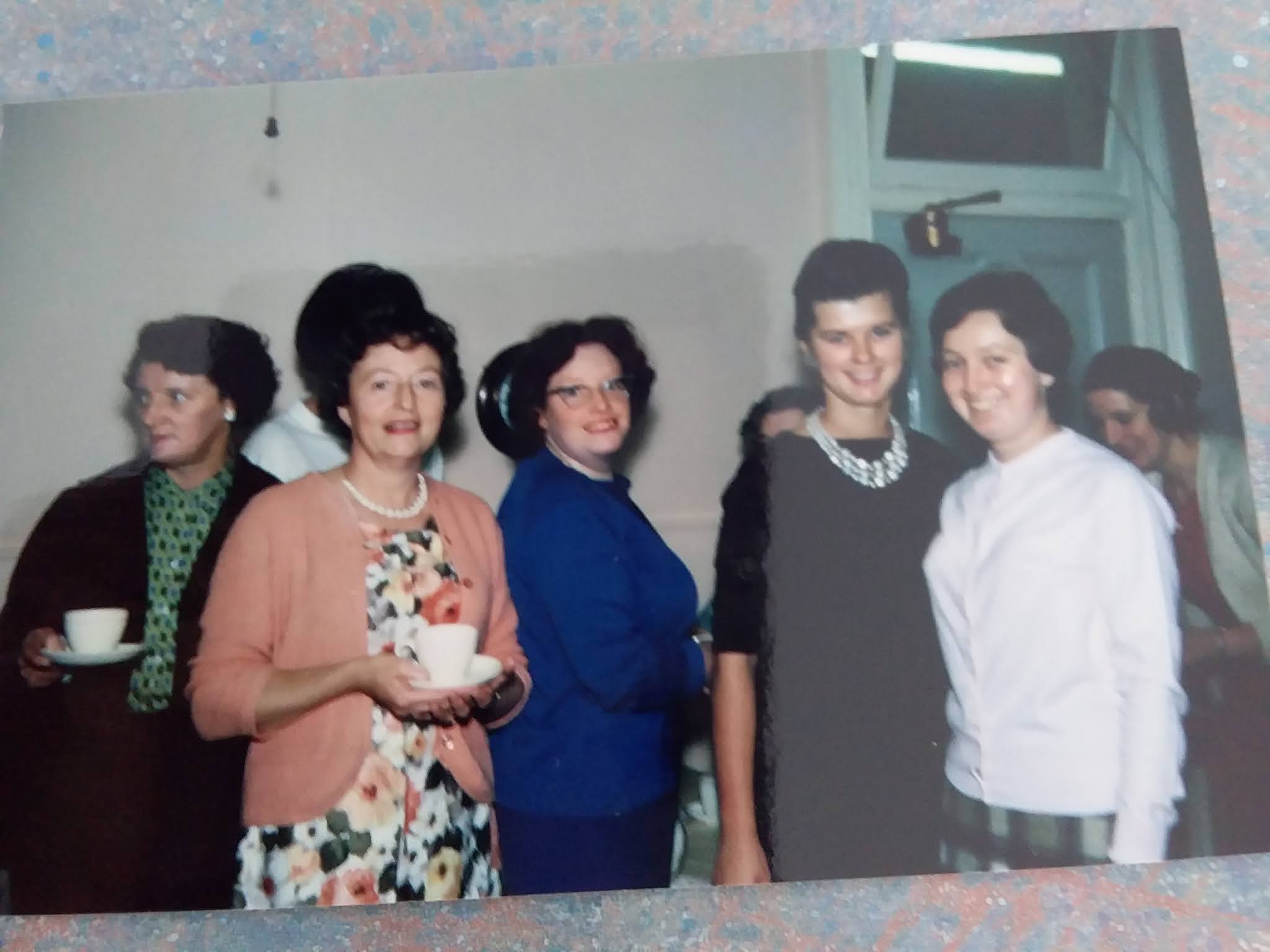
All Education typists and secretaries, both inside Govt Bldgs and in any of the outlying areas, were invited to the annual typists' Christmas morning tea -  


Franci is in the foreground.  She'd let someone else use her brand-new camera to take these slides!  Val is behind Franci.  


Tuesday, October 26, 2021

Typist-in-Charge, episode 7

 TYPIST-IN-CHARGE

Episode 7

Typing Room 305, Government Buildings, Wellington, NZ, 1960's


It was a rite of passage in Typing Room 305...  21st birthdays were a big thing.  So were marriages, Christmas, farewells, and going away to Australia for a 2 week holiday (such an adventure for me!).

Today was the day I was celebrating my 21st.  I was relieving at Stores Division in Thorndon.  But the office sent a car for me and I was feted like a queen at a special morning tea.  They'd even invited my mother.

The 'girls' chipped in with food from home, and there was a 21st birthday cake.  The cake probably came from the Art Craft Cake Kitchen which was up the road, opposite Parliament Buildings;  all our  sponge cakes and sausage rolls  came from there.

I was presented with a lovely jewellery box which I still have to this day.


above:  that's my mum behind me


above:  room 305.  We shoved two typists' desks together.


above from right:  Miss Hopkins, Mrs Parr


above: from right front: Sheila, Val.    Val had her 21st three months before me and she received two beautiful vases.


PS: I was burrowing away in an old suitcase and I found the above slides (slides? huh?) that Francie, typist, had taken of my 21st birthday.  Wow, was I ever so young?


Thursday, August 26, 2021

TYPIST-IN-CHARGE Episode 6


TYPIST-IN-CHARGE

Episode 6

Typing Room 305, Government Buildings, Wellington, NZ, 1960's


Mrs Rowley, Typist-in-Charge, sent me to the Child Welfare Division in the Dominion newspaper building to relieve there for a week or two.

"I've given instructions to the office that you are not to type abuse cases," she said. 

I didn't really understand what she was talking about.

Later on, when I found out the types of terrible cases involved, I was so glad that my boss had kept me away from it all.

However, I still smile when I think of an overseas person who had written a letter to Child Welfare headed up "Dear Mr Bag-"  The envelope was addressed "Mr P. Bag".  Child Welfare's address was "Private Bag, Wellington".

Not only was I sent relieving around Education outer offices, but after my first year away from school, I was paid an extra 50 pounds per annum to be a dictaphone-typist.  I wore head-phones on a cord connected to the dictaphone on my desk.  There was a choice of a connected foot pedal to operate the dictaphone or a connected hand control which was a wide bar that sat in front of the typewriter, and I would bring my thumb down to buttons to 'stop' the machine, 'fast forward' or 'reverse' the tape.  A taxi stand was in front of Government Buildings and often I would get their messages through my earphones.  Knowing that one guy was going to knock off and get fish and chips for lunch was somehow exciting listening. The speaker of the very first job I typed from the dictaphone kept using the word 'period'.  I typed the word 'period' all through the manuscript.  It didn't seem to make any sense.   Turned out the old-fashioned word meant 'full-stop', and was an instruction to me.  

Dictators were supposed to preface every instruction during dictating with the word 'typist...'.   For example, "Typist:  I want the following set out in two columns, thank you."  Otherwise a typist  would be halfway through typing the instruction before she realised it was meant for her, and not to be typed.  Sigh, paper to be pulled out of machine, new paper to be rolled in, job to be started again....

The secretaries to the directors were the elite of the typing force.  They breezed into the typing room every now and then because their bosses had demanded they at least look busy and they should go and help out the pool (one secretary was quite vexed when told that knitting on the job was a bad image to project to the public). The secretaries rummaged through our pool's in-box and always took long drafts that were to be done in double-spacing.  With a saint-like sigh they never forgot to announce, "I'll take this long job to help out."   We basic grade typists sniggered because double-spaced drafts were the easiest things in the world to type.  All of a director's most difficult typing jobs, like tables and columns, came to the pool.

However, there was one secretary's job I craved: secretary to the Director (Admin).  For the first hour or two each morning, she would sit at her desk and read all the newspapers.  If she saw any article referring to the Education Department she would clip it out, put it in a folder and give it to her boss.

Way before ex-supervising typist-in-charge Miss Hopkins, ended up in the 1960's typing pool as a retiree worker, she had been secretary to Dr C E Beeby who was Director (Admin) for a time, followed, in 1940, by Director of Education (the position was later given the title 'Director-General')

Dorothy Hopkins was on holiday when she was a young secretary. She was on the inter-island ferry going down to Christchuch.    Leaning over the ship's railing and looking at the sea, she suddenly sensed a man at the other end of the railing, slowly shuffling his way closer and closer to her.  She was frightened, staring straight ahead, not daring to look at the guy.  He got so close to her that Miss Hopkins felt his arm against her coat sleeve.

She gave a yell, and raised her handbag to rain it down on this would-be pervert- 

Dr Beeby grinned.  "I'm glad to see you're a good girl, Dorothy," he said.  "... prepared to defend your honour at any cost."


above: Miss Hopkins and me (Sheila's wedding, 1960's)


above:  Dr C E Beeby


Friday, July 16, 2021

Typist-in-Charge, Episode 5

 TYPIST-IN-CHARGE

Episode 5


Typing Room 305, Head Office, Department of Education, Government Buildings, Wellington, NZ, 1960s

Along the corridor, next to the typing room was the small teleprinter room, with two operators.  There were two big machines that allowed us to type memos and drafts to officers at the Auckland and Christchurch offices who, in turn, could send work to us at Head Office.  A roll of paper was in each machine.  A teleprinter operator couldn't change anything in her typing, so accuracy was essential.  Incoming memos arrived in red type.  Our outgoing ones were black


above: google photo of 1950's teleprinters, similar to ours

I was often sent to relieve when one or other teleprinter operator was away.  The good thing about the machines was that we could talk, via typing, to real live operators at the other end.  I was typing away happily one day in the teleprinter room when the other operator, Gwen, said, "Oh, the woman on the machine in Auckland has told me that she's been sent home with the measles - "

Gwen looked down at her own chest.  It was summer and she had a low neckline.  "Noooo, I think I've got measles too!"

She was off work immediately.  We kidded her about catching measles over the teleprinter.

Another time, after I had confessed my love for The Beatles who were touring New Zealand, one of the teleprinter relievers from the Christchurch office somehow managed to get into a press conference as a photographer, and he sent me a glorious photo.  I still cherish it.

An education inspector in the Christchurch office who had some time back been relieving in Wellington sent a teleprint message congratulating me on winning a cruise.  This was Bill Renwick.   My boss, Mrs Rowley,  pointed him out when he was a young whippersnapper and said to me, "You keep an eye on that young man, he'll be director-general one day-"  And he was.

Whilst talking to the typists, Mrs Rowley often balanced backward on her chair, with one hand on the ancient water radiator under the window (the radiator had old-fashioned embossed Victorian-like curly twirls and scrolls on it, and over the years had been painted to match the wall colour).  Mrs Rowley's other hand would rest lightly on her electric typewriter.

"-owww!"  Mrs Rowley disliked the little electric shocks that went through her body when she regularly did this action.  With a sigh, she would try to remember not to touch the radiator and her typewriter simultaneously. 

Opposite the teleprinter room was a door marked 'ladies'.   Once through the door, the ladies' toilets were accessed by way of a steep wooden staircase to a narrow attic-type area.  Under the staircase was the kitchen in which the tea lady bustled around making up our morning and afternoon teas.   A discreet knock on our door at 9 45 am and 2 45 pm, and one of the typists would rush away from her machine to help manoeuvre the heavy tea trolley into the typing room.

Often we typists would go to the basins in a room beside the kitchen and get a drink of water.  For weeks we complained about the water looking brown (we still drank it).  Eventually when feathers started to turn up in the water Admin Section called in a plumber.

"The wire netting over the roof's water tank is torn," said the plumber.  "There's a dead seagull in the tank..."

Wednesday, May 19, 2021

TYPIST-IN-CHARGE, Episode 4

 Hi there

Typing Room 305, Education Department, Government Buildings, Wellington, NZ.  1961.

***

Miss Hopkins was now a Staff Typist, sitting in a typing  pool like we other peasants, but until her recent retirement she had been the Supervising Typist-in-Charge of all Education typists, with her own room no less.  We loved hearing her stories about how she started in Education some forty years back - 

When Dorothy Hopkins was a sprightly junior typist, about 17 years old, there was a stiff protocol involved when addressing others.  It was all 'Miss', 'Mrs', 'Mr';  no first names allowed.  The Typist-in-Charge at the time was a Miss Peggy Patrick.  One evening the typists were all out to dinner.

Dorothy Hopkins, no doubt with a gleam in her eye, and in some trepidation but with a hint of a rebellious soul in her young body, asked "Would you pass the salt please ...  Peggy?"

There were a few sharp intakes of typist breath across the table.  Quickly muffled giggles came from a couple of the juniors.

Peggy Patrick passed over the salt.  "Here you are ... Miss Hopkins."

When I joined Education in 1960, I called all the older typists 'Miss' or 'Mrs'.  They called me 'Lorraine'.  By the time I got to senior status, everybody in government departments were called by their first names, so I never got to experience the heady pleasure of being addressed with a prefix.

As a junior I was required to sit the Public Service Typing Exam.  It was the most recognised typing exam in NZ.  My work typewriter had been  bundled up on the day before the Saturday November 1961 exam and sent to Gilby's Business College in Willis Street.  I'd brushed inside the keys basin with methylated spirits, picked out the gunk from the letters 'b', 'd', 'e', 'p' and  'o'' with a bent paper clip, wiped the wax off the main roller where I'd used a stencil* the previous day, and polished the keyboard until it gleamed.

The speed test was to be scheduled first.  Then an hour's break for me before it was time for the confused manuscript part of the examination.

Oh, and I forgot to mention, dear reader,  exam day was the exact day Cliff Richard, Britain's King of Rock'n'Roll, would be in Wellington.  Did I also forget to mention that I was a rabid Cliff Richard & The Shadows fan?  Cliff had turned 21 the previous month, and was young and gorgeous.

In my hour's exam gap I sprinted down Willis Street to the Hotel St George where the boys were staying, and I met up with two friends.  There was a metal fire escape clinging to the side of the hotel -

We climbed it, of course.  Right to the top floor (seventh?).  It was a scary escapade but, hey, this dare-devil climb was done with the hope of seeing Cliff in his - sigh - bedroom, and breathing his same air, swooning over him.

We peeked through a window and, heavens(swoon!), there was Jet Harris, bass guitarist of The Shadows.  He gave a girlish shriek and ducked behind an open wardrobe door.  Oops ....  We scuttled back down the fire escape.  First one off the contraption, I raced up Willis Street but my friends, not so lucky, were caught by the hotel manager.

I arrived at my exam venue puffing, panting, heart racing, mind exploding, and it was one minute before the exam started.

I failed the exam.  Any wonder why? 


above:  Hotel St George, Wellington.  The Beatles stayed here in 1964.

PS:  I passed the exam the next time around.


PPS:   * a stencil was a foolscap sheet of lightweight cardboard with a waxy sheet atop.  A cardboard strip ran across the top of the stencil with perferated holes in it so that the typed stencil could be slotted into a Gestetner machine and hundreds of copies of the typing could be run off.  A red liquid could be brushed over a typed mistake and after a few minutes the typist would type the correct letter on top of the set liquid.  Stencils were not typed with a ribbon.  There was a small lever at the side of the typewriter that would move the ribbon down from its usual place to enable a key to heavily penetrate the stencil.